My on-going Black Tower adventure game had long ago stretched out beyond the initial dungeon location with transits between nearby town and back, then on to other regional dungeons, and now across the high seas. Placing before my players an far away ocean destination I had intended offer a few island locations sketched by a favorite designer Gabor Lux. Though I couldn’t recall if these were fist published in Knockspell or the Fight On ‘zines.
As I set about leafing through hundreds of pages of OSR material from the halcyon days of 2008, and thinking to myself: “there is so much interesting material here. How will I hope to recall it’s location for some future game? I need a sort of index…”
Checking with an academic friend I settled on the conspectus model, collecting details on: issue, page number, article title, article category, author, and any additional notes I might care to add.
noun con·spec·tus (kən-ˈspek-təs)
1: a usually brief survey or summary (as of an extensive subject) often providing an overall view
You can find the start of this conspectus here, which currently covers the first 4 issues of Fight On! My plan is to publish regular updates to this work, but I would certainly welcome other contributors. Also I would be happy to see anyone take and expand on this format for other materials.
As this material is published in a Google sheet it should be easily sorted, filtered, analyzed, or exported. I would suggest making a copy of the file for these purposes if necessary.
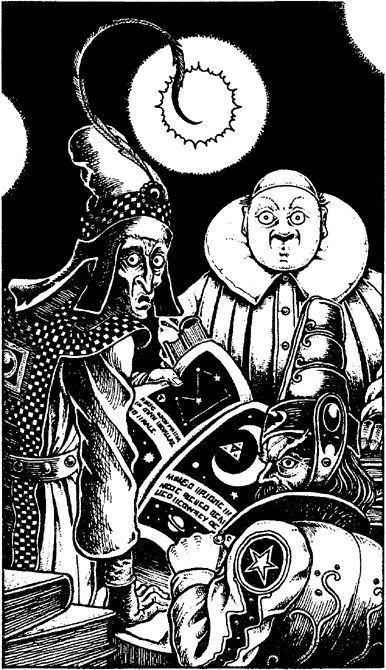
Portion of the AD&D 1e DMG as illustrated by David Sutherland, filtered via Prisma, Gothic
I am an unabashed AD&D 1e enthusiast, but I certainly appreciate this game isn’t for everyone. For me 1e is as beautifuly complex and powerful, like a formula 1 race car. Like a like a race car it needs specialized tools and training to operate.
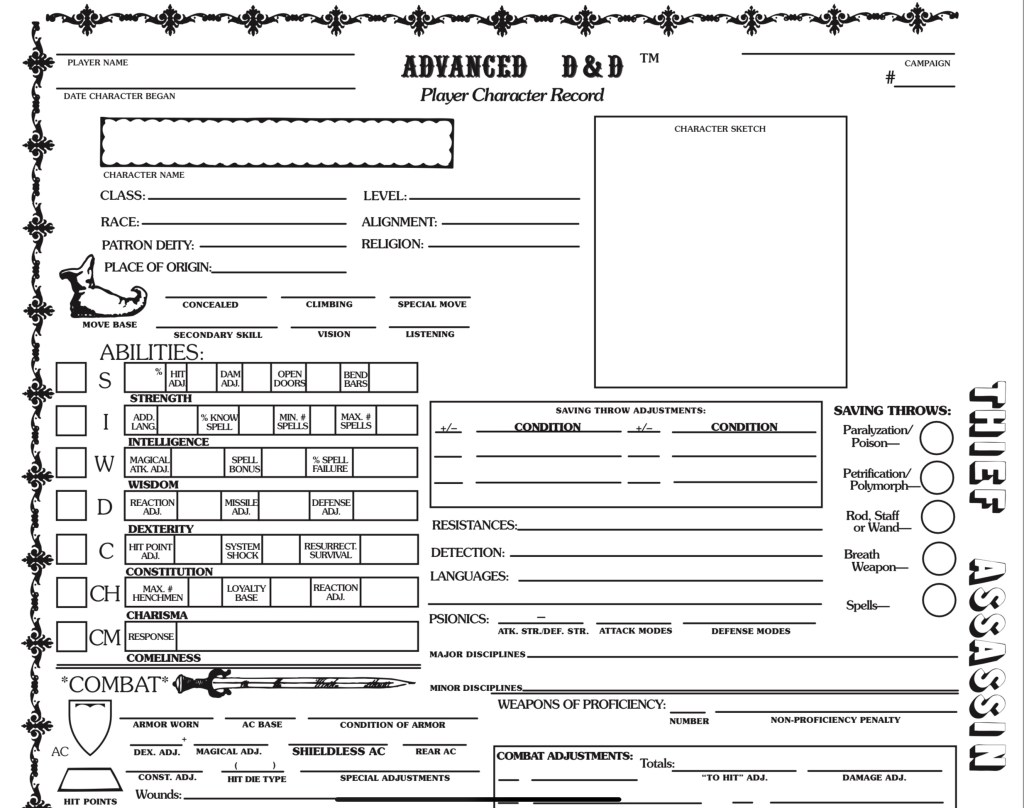
As a player one of the key tools is the classic character sheet, which was originally designed to capture as much detail any player could need for play without referring to the core books. In all my plays over these past few years I immediately returned to this familiar tool. However, this sheet requires a sharp pencil, a good eraser, and keen eyesight; all of which fail me in one way or another from time to time.
Get pdf versions of these MadIrishMan classics here
I have been playing in a regular bi-weekly game, but with our astral plane adventures I realized that my careful scribblings were an inefficient nod to the past. Casting around online for a cloud based AD&D 1e character sheet I found a number of Google Sheets that approached what I was looking for, and using one of these as a baseline I tweaked it for my own needs.
Snapshot of the latest iteration of this 1e character sheet, grab a copy here
If you have an interest in playing AD&D 1e I can suggest two additional resources.
1. Anthony Huso has written extensively on playing 1e RAW on his blog: The Blue Bard.
2. Allan Grohe my 1e DM also keeps a blog with plenty of interesting content on this topic: From Kuroth’s Quill
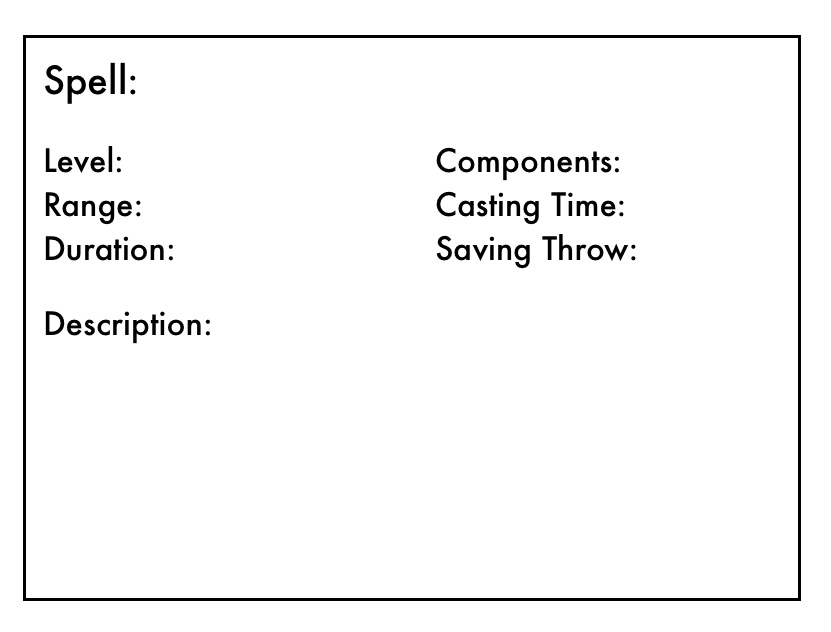
September 18 Update – Spell Cards
Print & Play spell cards, should be just shy of 2.5” x 3.5” that is the standard for CCGs. Get them here.
July 21 Update
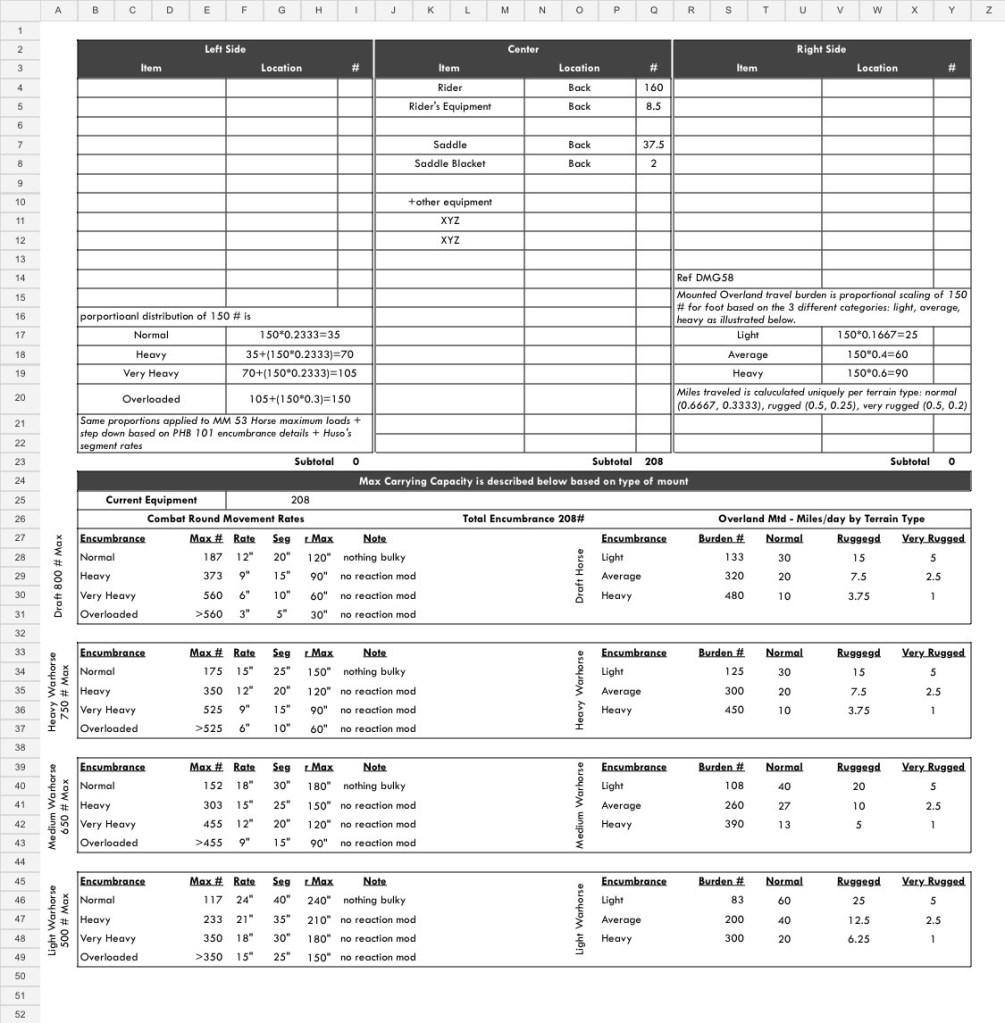
I’m leading a group of players tentatively towards Huso’s Castle of the Silver Prince. Our goal to hew as close to the 1e core rules as possible: 6 second segments, weapon modifiers vs AC, grid based combat, level caps, training, the whole lot of it.
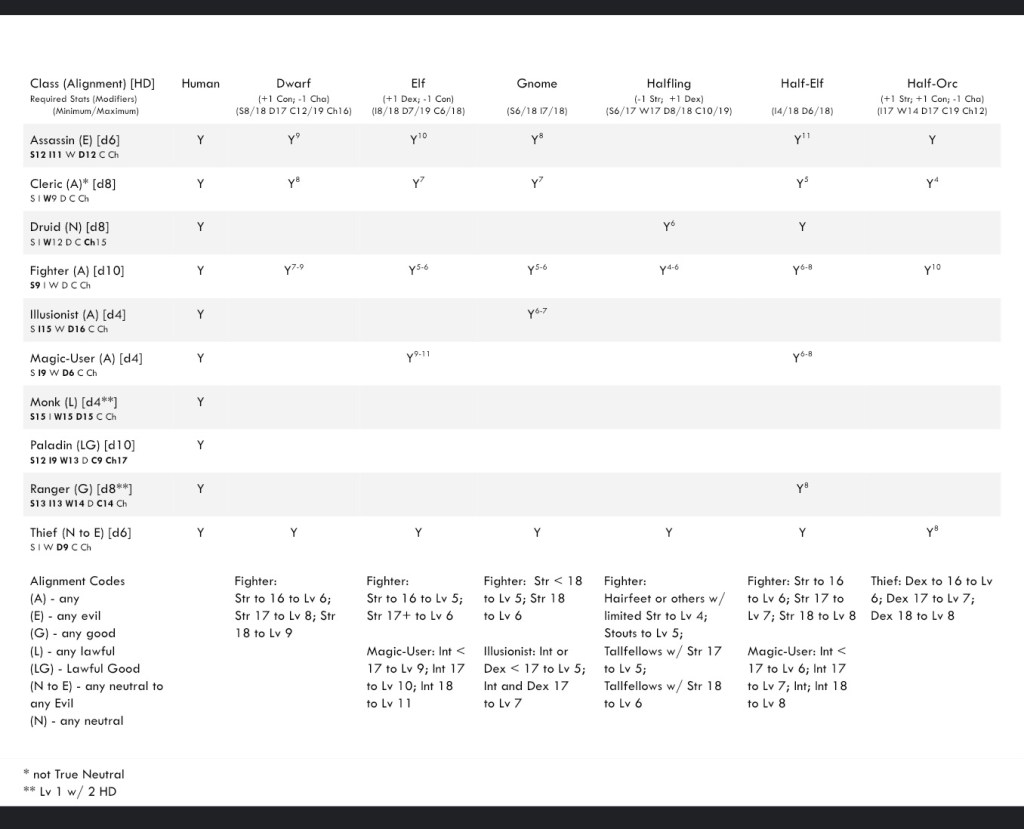
In my own study and prep of the system and creating a sample character I wrestled with the scattered class and demi-human requirements. All of this I initially consolidated to a single page, but has since grown to 5, which you can find here.
While crawling the web for an old school D&D mystery I stumbled on a pdf of Different Worlds No. 4 from 1978. In those pages are plenty of insights of the early days of the hobby. Most exciting to me was an article by J. Sapienza with many d1000 tables to “produce interesting and unique magical weapons”
To the Google Sheets! We now have a tool to quickly produce magic weapons in-line with Sapienza’s original ideas. Find that tool here.
Some examples of the tools output follow and while the formatting is a bit rough the text can be easily captured and modified to suit any need.
Finally, Sapienza mentions that his article was originally published in issue 32 of “The Wild Hunt”. Another old school D&D mystery that requires investigation – RPG Geek gives a clue here, but I’m no closer to reading those ancient pages.
If you can help with digital scans of The Wild Hunt I would be most interested.
Wizards, Magic-Users, Sorcerers, and Spell Casters – what clearly makes them unique are the spells cast, enchantments woven, sorceries worked, and mysteries unlocked. Though many magic-users are painfully similar to any other when it comes to the spell book itself. Level 1 is more than likely to contain tried and true favorites: sleep, detect magic, protection from evil perhaps.
Campbell has already written eloquently on the subject and there is perhaps little I can offer when compared to this opus.
No Wizard is happy.
Imagine a doctor, years of study. Chooses to become a proctologist. There’s a reason. Yes: money, job security, comfort. Still, to devote so much time to assholes, looking at asses of mostly older men and women, thinking about what the health of a colon really means, nobody that has the opportunity to become a doctor would choose something like that if it didn’t resonate with them at least a little.
What I can offer is a tool that will provide access to over 2000 magic-user spells compiled over a 20 year period from a variety of AD&D resources. 254 level 1 spells alone, astonishing. Certain to bring some variation to any spell book.
In 1996 TSR produced the AD&D Wizard Spell Compendium, a remarkable summary of AD&D spells published during the period of 1975-1995 and now available digitally on DriveThruRPG.
In 2017 the blogger “Delta” published a .csv of key of the entire compendium, providing spell details along with some data analysis. Their work here.
My effort was to consolidate “Delta”‘s .csv & convert to a traditional “workbook”, while also adding some lookup funcitons for random spell selection by level.
With this tool magic now appears weird, unexpected, and new. I hope you too will find it so.
…Motorhead toured England, but more importantly for me White Dwarf No. 9 was published. This issue of a “new” bi-annual British tabletop game magazine included (as far as I can tell) the first ever dungeon published in a periodical: The Lichway by Albie Fiore. The Dragon magazine would follow suit a few months later in the a US. However, that dungeon offering would pale in comparisons to the White Dwarf material.
Fiore’s Lichway is a remarkable piece of work: multiple factions in a strange environment, well scaled for low level play, while offering useful awards, and a challenging puzzle. More importantly this a is an excellent example of how the game was played in earliest days. I knew that when I first glanced at the hand drawn map I had to run this this dungeon and share it with as many people as possible.
To that end I spun up a roll20 session: importing the map, laying out the dynamic lighting, sketching in a few key details for the rooms, adding monster tokens, and preparing both DM & PC handouts. For about a month a group of old school enthusiasts have on a near weekly basis to plunge the depths of the lichway. As the DM I have greatly enjoyed the process of studying the dungeon and considering the best way to present it to my players.
The bigger challenge has been how to share this with a broader audience. 1) the roll20 marketplace is a bit complex to setup and doesn’t fit with my personal model of “free” content. 2) could invite other DMs to use my existing roll20, but that could restrict the number of games and could result in unintended changes to the roll20 module. 3) publish an asset pack that would allow other DMs to setup their own lichway session, you can get that asset pack here.
What’s included:
a player map, with the room numbers removed (this from the original White Dwarf
PC handouts for a boat, inscription, and demon
DM handouts covering an introduction, wandering monster table, a monster index, and an NPC index
a collection of VTT tokens to support online play, these sourced from game-icons.net
full color player and DM png maps << new for ‘24
Dungeon Scrawl v1 files << new for ‘24
Aa brand new copy edit of the dungeon providing a complete key for ease of reference << new for ‘24
Some notes about running the dungeon:
the interior of the original dungeon map does not include grid marks, which may be confusing for some players
the hand drawn nature of the grid of the original dungeon map makes alignment within roll20 challenging, I would suggest close enough is good enough
the wandering monster table is my own creation, as the original key calls only for wandering monsters outside the the temple
the key itself is leaves plenty of room for DM interpretation & improv moments – go for it!
I’ll ask some of my players to leave their thoughts on the lichway here. I’d also be interested to hear your own group’s experience in playing this classic.
January 2021 Update
Have just finished laying out Albie Fiore’s “The Lichway” in Dungeon Scrawl. Dungeon Scrawl is an excellent online map making tool. Features include infinite canvas, infinite layers, and tools designed for dungeon mapping. Circles & arches are a bit tough but a creative approach can yield some useful result.
Zip package linked above provides a new player map suitable for use in your favorite Virtual Tabletop.
Ever wonder what treasures are hidden away in the hoard of the Halfling Master? Dig into this blog for news, ideas, reviews, and other in depth information about anything surrounding the OSR, TTRPGs, and Miniatures hobbies. No piece of loot is too small or insignificant to be explored.